
2026 State of Construction Service Operations: The $204,000 Call Centre Liability Report
The Shift from Fixed Costs to Performance
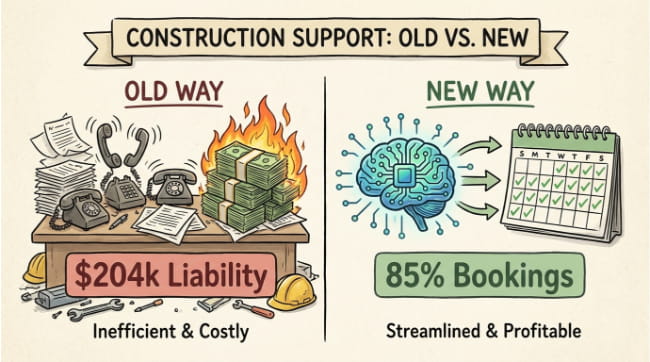
The traditional model of staffing a construction service desk is broken. For multi-site operators managing complex logistics, the math no longer works. We are witnessing a rapid shift where fixed-cost human teams are becoming a liability rather than an asset.
The financial sustainability of in-house call centres is collapsing. Recent data indicate single-agent costs now exceed $200,000 annually in Australia when factoring in total cost of ownership.
Early adopters in the trade sector are replacing fixed-cost human teams with AI agents. These firms are achieving booking rates as high as 85% within weeks of deployment, effectively turning their support cost centre into a revenue generator.
The traditional outsourcing model ($40-$67/hour) is failing. BPOs are unable to close the gap on missed revenue from unanswered calls, often lacking the local context required for high-value trade negotiations.
Primary recommendation: Multi-site operators must transition from headcount-based support to outcome-based automation. This is the only way to protect margins while scaling operations across multiple locations.
Market Analysis: The State of Australian Construction Support in 2026
The Australian construction and trade services sector faces a unique labour crisis. Administrative costs are outpacing operational revenue growth, leaving businesses in a precarious position. You might be managing six different businesses or locations, yet you are stuck paying for a singular, inefficient support structure.
Businesses are currently trapped between two losing options. You can hire expensive local staff who demand high salaries and flexibility, or you can turn to inconsistent offshore outsourcing. Neither solves the core problem.
The "middle ground" of traditional BPOs is eroding. Market analysis from 2025 shows Australian outsourced agent costs ranging from $40 to $66.97 per hour. Paying a premium for an offshore agent who doesn't understand the geography of Sydney or the urgency of a site shutdown is a bad trade. Service quality in these hubs fails to justify the hourly rates charged to Australian firms, leaving operators drowning in overhead while leads slip through the cracks.
The Numbers That Matter: The Real Cost of 'Human-First' Support
Most operators look at a base salary of $80,000 or $90,000 and assume that is their cost. That is a dangerous oversimplification. The total cost of ownership for a human voice channel is significantly higher.
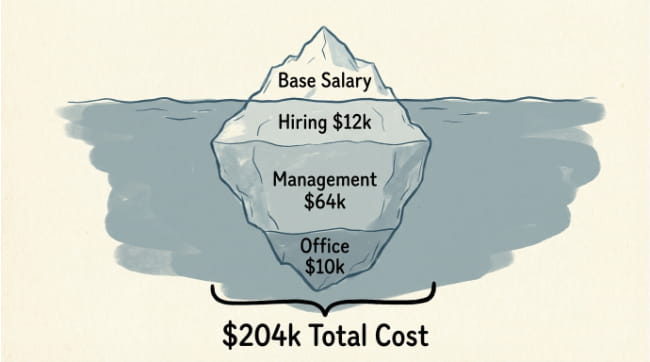
Unity Connect data reveals the total annual cost per agent in Australia has hit $204,111. This figure includes the hidden bleed that destroys cash flow:
Hiring expense: $12,000 per head before they even answer a phone.
Manager amortisation: $64,505 allocated to supervising that agent.
Infrastructure: $10,000 for office space and $3,600 for hardware.
Beyond the hard costs, the opportunity cost of the "human limitation" is the silent killer of growth. A human agent can only answer one call at a time. If three calls come in at 8:00 AM, two are missed. In the trade sector, where a missed appointment is worth between $200 and $500, those dropped calls accumulate into hundreds of thousands in lost revenue annually.
One of our clients, a multi-site operator in Sydney, looked at these numbers and made a definitive call. They realised that paying $204,000 for a system that still misses calls was unsustainable. In their words, they needed their expensive call centre to just be "bye, bye."
Tired of paying $204,000 for a call centre that still misses calls? Hear how our AI handles a construction inquiry in 30 seconds. Test Drive Alex now; no forms, no signup.
Leading vs. Lagging Indicators: Why Traditional Metrics Fail
Construction firms often measure the wrong things. They focus on minimising costs rather than maximising capture. To fix this, you must shift your KPIs from lagging indicators to leading ones.
Lagging Indicator: Cost Per Hour. Focusing on whether you are paying $40 or $50 per hour ignores the revenue lost from missed calls. Saving $10 an hour is irrelevant if you miss a $5,000 project because the line was busy.
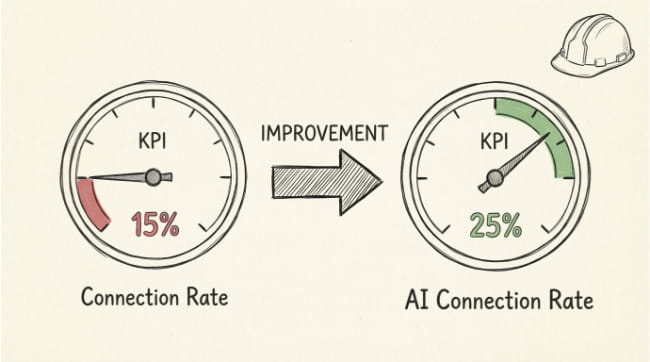
Leading Indicator: Booking Conversion Rate. High-performing firms measure success by confirmed jobs. Traditional connection rates hover between 8-15%. AI-enhanced operations are seeing connection rates jump to 20-25%, directly impacting the bottom line.
The Efficiency Gap. Traditional centres struggle with capacity during peak times. This leads to a 27% abandonment rate. No amount of hourly savings can recover the revenue lost when over a quarter of your potential clients hang up before speaking to anyone.
Technology Impact Analysis: How AI is Reshaping Trade Revenue
Artificial Intelligence has moved beyond simple chatbots. We are now deploying fully autonomous voice agents capable of complex negotiation and scheduling. For a multi-site service operator, this changes the game entirely.
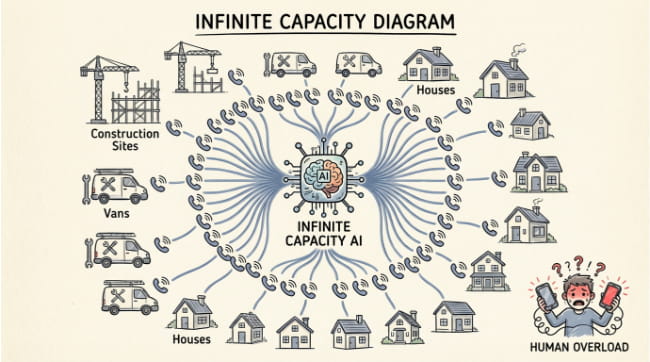
This technology offers "infinite capacity." It means you can scale customer service instantly across six different businesses without linear cost increases. If a marketing campaign triggers 50 calls in ten minutes, the AI answers all 50 simultaneously. There is no busy signal. There is no hold music.
Industry data supports this shift, with 78% of manufacturing executives reporting measurable returns from AI investments. In addition, AI reduces the cost-per-interaction by $5-$7 compared to human agents. But the real value isn't just the savings; it's the scalability. You can process thousands of calls without dropping leads, ensuring that your operational overhead remains flat even as your booking volume spikes.
Revenue Generation Opportunities: The 85% Benchmark
The primary driver for AI adoption in construction is revenue capture. Automated agents follow best-practice scripts with 100% consistency. They never have a bad day, they never forget to ask for the sale, and they never sound tired at 4:30 PM.
This consistency eliminates the "human error" factor in lost leads. Immediate follow-up and 24/7 availability directly correlate to higher conversion rates for high-ticket trade jobs.
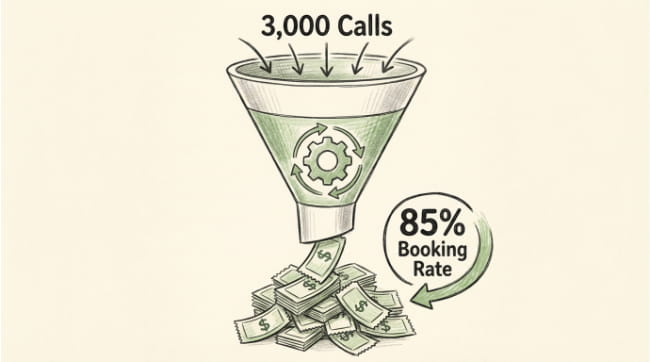
The results are tangible. One of our clients, a major trade business in Sydney, processed between 2,000 and 3,000 calls in just a couple of months after switching to autonomous voice agents. The outcome was an 85% booking rate. That is the new industry standard. If your current human team is converting at 40% or 50%, you are leaving massive revenue on the table.
Case Study Snapshots: Real Results from the Field
The decision to say "bye bye" to a traditional call centre is not theoretical. It is happening now across Australia.
Multi-Site Trade Operator (Sydney). A multi-site trade operator in Sydney faced a critical bottleneck while managing six distinct business locations. The overhead of a centralised human call centre had become a financial liability, yet decentralising support risked inconsistent service quality. They required a solution that could centralise operations without the linear cost scaling of human agents. By deploying an autonomous voice agent, the firm automated their entire front desk within a three-week window. The system successfully processed 3,000 calls during the initial rollout phase, effectively removing a $200,000+ operational liability while standardising the customer experience across all six locations.
Specialist Repair Services (Garage Door Co). A specialist garage door repair service struggled with severe staffing shortages during their peak operational season. High call volumes meant that existing staff were overwhelmed, leading to missed inquiries and lost revenue opportunities. The business needed to maintain booking capacity without the lead time required to hire and train new administrative staff. Implementing an AI voice agent allowed them to replace the workload of two full-time employees immediately. In under two months, the automated system booked 1,360 jobs, ensuring zero missed leads during the rush. The efficiency gains were so significant that the technology investment paid for itself within days of activation.
Real Estate Agency. A prominent real estate agency identified a consistent loss of leads occurring outside of standard business hours. Potential clients calling on weekends or evenings were met with voicemail, resulting in low callback conversion rates and lost listings. The agency sought a method to capture these inquiries instantly without incurring the high costs of penalty rates for after-hours human staff. By integrating an always-on AI agent, they bridged the availability gap. The system now autonomously qualifies and books 35 to 40 appointments every week, operating 24/7. This shift has secured a steady pipeline of qualified prospects that were previously slipping through the cracks.
See the real numbers behind these results. Explore our construction case studies to see how businesses like yours replaced their call centres and increased revenue.
Implementation Readiness Assessment: Is Your Business Ready?
A common fear among operators is that new tech requires a long, disruptive implementation. You might be thinking, "We need a solution in weeks, not months."
The reality is that transitioning to AI voice agents requires less technical overhaul than most legacy CRM implementations. The critical factor is not software compatibility, but process clarity. If you know exactly how a lead should be handled, the AI can learn it instantly.
Modern AI agents plug directly into your existing ecosystem. Assess whether your preferred solution integrates deeply with your existing tools, such as ServiceM8, Cliniko, LEAP, and HubSpot. There is no "rip and replace" of your core operational software. You keep your dispatch tools; you just upgrade the voice that feeds them.
For the Sydney client mentioned earlier, the timeline was explicit: "Three weeks later, call centre, bye, bye." That is the speed of modern deployment.
Future Outlook: What Construction Operations Will Look Like in 2028
The industry is moving toward "Zero-Touch Administration." In this model, the first human interaction occurs on the job site, not on the phone.
Voice AI will evolve from booking appointments to handling complex project management queries and supplier logistics. We are already seeing pay-per-resolution models emerging, costing between $1 and $7 per resolved task.
With the global call centre AI market growing at a 21.3% CAGR, firms that retain manual call centres will face an insurmountable overhead disadvantage. You cannot compete on price or speed if you are carrying a $204,000 liability that your competitors have eliminated.
Action Framework: Next Steps by Business Size
To replicate the success of the firms mentioned above, you need a specific plan based on your scale.
Small Operators (1-10 Staff): Focus on 'After-Hours Capture'. Your immediate goal is to stop revenue leakage. Deploy AI to handle overflow and weekend calls. If you miss five calls a week, that is potentially $2,500 in lost revenue. Target: Recover $2k-$5k/month in missed jobs immediately.
Multi-Site/Franchise Groups: Focus on 'Centralised Displacement'. This is the strategy for the operator managing six businesses. Replace the $200k+ in-house team with a unified AI receptionist that routes leads to local branches. This removes the management burden and standardises the customer experience across all sites. Target: Reduce overhead by 60% while increasing booking consistency to the market-leading standard.
Enterprise/National: Focus on 'Full Integration'. Deeply embed AI into your CRM for automated dispatch, follow-ups, and customer reactivation campaigns. The AI should not just answer calls; it should manage the lifecycle of the customer. Target: Full automation of Tier 1 support and dispatch.
Find out where your business sits compared to these benchmarks. Book a discovery call to map your readiness against the operators already making this transition.

