
The Complete Guide to Automated Property Management: 5-Step Framework for Real Estate Agencies
How Manual Data Entry is Quietly Killing Your Profitability
Real estate agencies are bleeding Net Operating Income (NOI). It is not happening because of market downturns or vacancy rates. It is happening in the "hidden factory" of your back office.
Most agencies invest heavily in premium Property Management Software (PMS) like PropertyMe or Console Cloud. Yet, they rely on human staff to manually feed data into these expensive systems. This disconnect creates a massive drag on profitability.
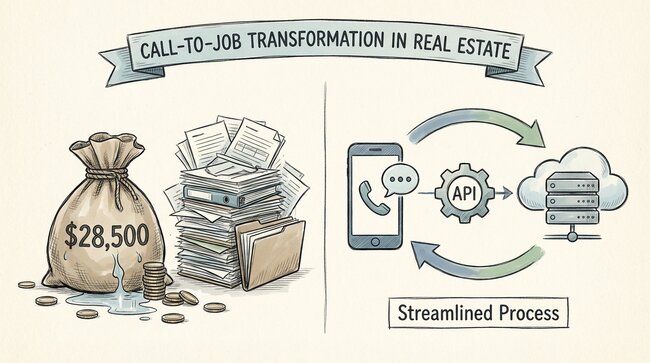
Research indicates that manual data entry costs businesses approximately $28,500 per employee annually.
Consider your current workflow. Property managers spend 30-40% of their time on manual data entry and reconciliation. They are transcribing voicemails, typing up maintenance requests, and manually entering tenant details. This is not high-value work. It is administrative friction that leads to staff burnout and errors.
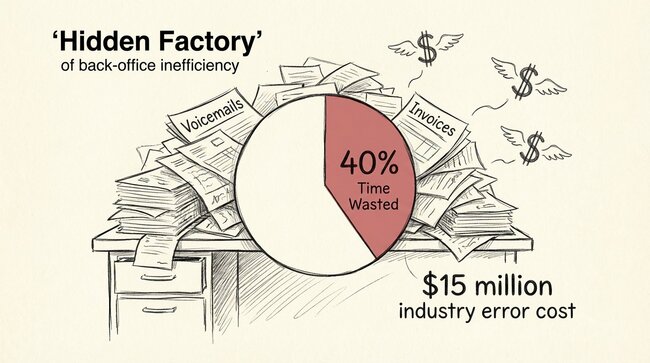
Industry-wide, data errors cost firms an average of $15 million annually.
The cost of inaction is quantifiable. Manual processes are a direct tax on your profitability. While agencies are willing to buy software, the reluctance to automate the input mechanism remains the single biggest barrier to scaling efficiency.
The Strategic Foundation: What You Need Before You Start
Automation is not magic. It requires technical and cultural readiness.
Technically, having a cloud PMS is not enough. You need open API capabilities. This is where many Principals hesitate. The cost of enabling API access often triggers budget concerns, yet it is the gateway to all future efficiency.
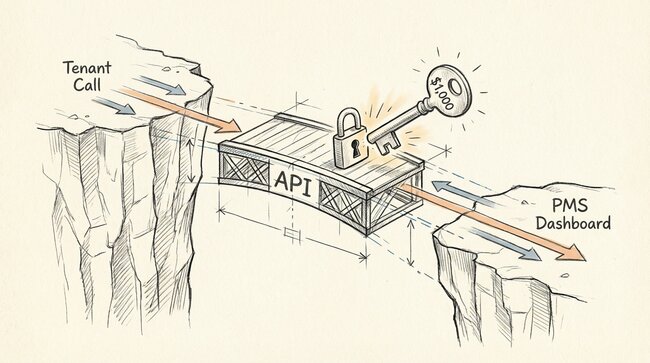
One of our real estate clients recently faced this exact decision. As the practice principal told us regarding the API fee: "Look, let's say, for example, if we do agree to pay $1,000.. then it's possible."
They recognised that the $1,000 investment was the only way to unlock the workflow. Without it, you remain part of the 46.2% of businesses that fail to adopt automation due to a lack of awareness or technical preparation.
Culturally, you must prepare your team. Data integrity is important. Automating bad data only scales chaos. Your team must be willing to relinquish "busy work" to focus on high-value relationship management.
The 5-Step Implementation Framework
This framework moves your agency from manual dependency to a "Call-to-Job" automated ecosystem.
The objective is simple. We bridge the gap between tenant phone calls and your Property Management System dashboard. We eliminate the "space where profit dies." This is the lag between a request coming in and a logged action occurring.
Step 1: Audit Your 'Hidden Factory' Costs
What: Conduct a time-and-motion study. You must quantify exactly how many hours your team spends transcribing voicemails and emails into your PMS.
How: Track every instance of manual entry for one week. Categorise tasks by "Maintenance," "Leasing," and "Arrears." Calculate the hourly burden using the $28,500/year benchmark. Look specifically at invoice processing, where manual workflows often exceed $10 per invoice.
Success Indicator: You have a definitive "Cost of Manual Entry" figure to benchmark against the API investment.
Common Pitfall: Underestimating the "switch cost." This is the time lost refocusing after an interruption. Employees often spend over 9 hours weekly just transferring data from emails and PDFs.
Step 2: Bridge the Voice-to-Data Gap
What: Deploy Voice AI to act as the frontline for all inbound tenant and landlord communication. Replace voicemail with active data capture.
How: Port your main line or overflow calls to VoiceAiro. Configure the AI to identify caller intent. It must distinguish between an urgent repair and a rental inquiry. Enable "Aussie" localisation. The Aussie Advantage is critical here. A genuine local accent builds trust that generic bots destroy.
Success Indicator: 100% of missed calls are converted into structured text summaries instantly.
Common Pitfall: Using generic IVR menus. These frustrate callers. You need conversational AI that listens and understands intent.
Is your team wasting 30-40% of their day on data entry? See how VoiceAiro captures caller details and creates a job in real time. Test Drive Alex in 30 seconds at https://voiceairo.ai/
Step 3: Configure the 'Call-to-Job' API Workflow
What: Connect your Voice AI directly to your PMS via API to automate job creation. This is the core of the "Call-to-Job" workflow.
How: Map specific voice triggers to maintenance categories in your PMS. For example, "hot water system" should trigger a specific maintenance category. Set up automated work order drafting for preferred trades. Configure the API to populate tenant details automatically.
Success Indicator: A tenant call results in a drafted job in your system without human intervention.
Common Pitfall: Failing to set strict validation rules. This leads to duplicate job logs.
An 85% conversion rate sounds impossible until you see the workflow. Analyse the exact client results and metrics that turned phone calls into $60,000 of first-week revenue. Review our case studies at https://voiceairo.ai/case-studies
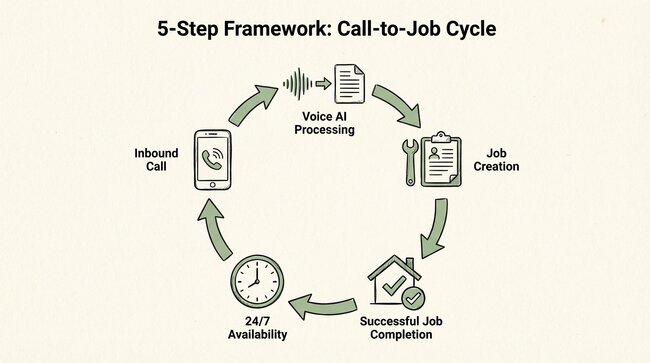
Step 4: Automate 24/7 Tenant Triage
What: Extend your agency's operating hours to 24/7 without overtime costs. Allow AI to triage emergency repairs.
How: Script the AI to distinguish between "urgent" and "routine" based on legislation. A burst pipe is urgent; a dripping tap is not. Automate SMS confirmations to tenants. Alert PMs only for true emergencies.
Success Indicator: Zero unlogged maintenance requests on Monday mornings.
Common Pitfall: Not updating the AI's knowledge base with specific emergency trade contacts.
Pro Tip: This step directly reduces staff burnout. 56% of burnout comes from repetitive tasks and after-hours pressure. VoiceAiro activates your tech stack 24/7 so your people don't have to.
Step 5: Reallocate Staff to Revenue Generation
What: Shift property managers from data entry roles to portfolio growth and client nurturing roles.
How: Update job descriptions. Focus on "New Managements" and "Landlord Retention." Measure staff on relationship KPIs rather than admin speed. Use the saved 30-40% time for proactive communication.
Success Indicator: Portfolio size increases without linear headcount growth. You are reclaiming 9+ hours per employee weekly for growth activities.
Common Pitfall: Failing to retrain staff. Do not leave them to "double check" the AI's work unnecessarily. Trust the system.
Measuring Success: KPIs and Optimisation
To ensure this framework delivers ROI, you must track specific metrics.
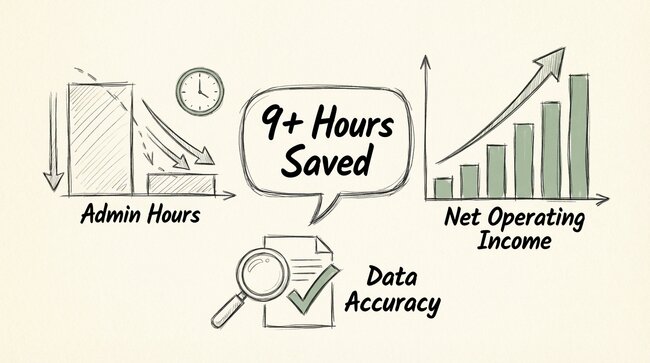
Primary Metric: Reduction in "Time to Log." This is the duration from call receipt to job creation.
Financial Metric: Improvement in Net Operating Income (NOI) per employee.
Optimisation: Regularly review AI call transcripts. Refine the vocabulary and improve intent recognition. Remember that inaccurate data alone costs firms $15 million annually. Accuracy is your safeguard.
Advanced Considerations for Multi-Office Agencies
Enterprise agencies face different challenges. You must consider standardising voice workflows across multiple locations to ensure brand consistency.
Compliance is non-negotiable. Ensure your AI workflow adheres to state-specific residential tenancy laws regarding emergency repairs. Integration depth matters. Ensure your API choice supports the specific compliance fields required by your state's legislation.
VoiceAiro supports deep integrations with platforms like ServiceM8, HubSpot, and others to manage complex ecosystems.
Stop losing $28,500 per employee to manual work. Book a discovery call to build your ROI plan for automating lead and maintenance intake. Schedule your call at https://voiceairo.ai/discovery-call
