
The Complete Guide to Client Retention: 5-Step Framework for Australian Home Services
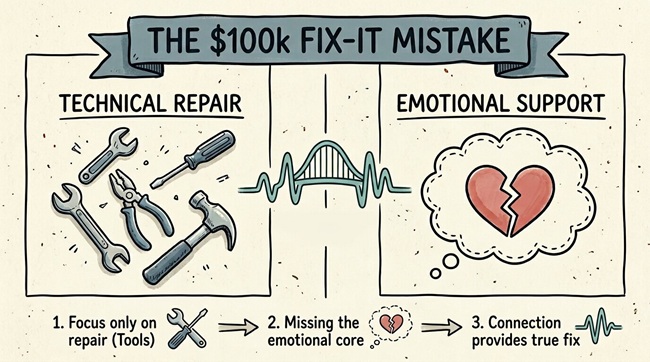
Why the "Fix-It" Instinct is Costing You 25% of Your Clients
One of our clients, an Australian home services practice, pinpointed the exact moment most client relationships break down. It isn't when the pipe bursts or the wiring fails. It happens during the first conversation.
As the practice principal told us: "Guys naturally want to fix a female's problem.. Sometimes they don't want to fix, they just want to be heard."
This psychological mismatch is the silent killer of retention in the trades. Your technicians are wired to solve technical problems immediately. But your customers often need emotional validation before they care about the technical solution. When a technician interrupts a venting customer with a solution, it feels dismissive.
The cost of this friction is brutal. Australian home services face client churn rates of 17% to 25% annually. Losing one in four clients every year isn't normal business attrition. It is a service failure.
Over 75% of that loss is attributed directly to poor customer service or experience. The customer doesn't leave because you couldn't fix the tap. They leave because they didn't feel heard.
This pattern appears repeatedly. A customer calls in distress. The team member jumps straight to "I can get someone out there at 2 PM." The customer feels rushed. The relationship erodes. You need a system that listens before it fixes.
Curious what an AI that truly listens sounds like? Don't just read about it. Talk to 'Alex' right now and experience how it handles a complaint without jumping to solutions.
The Strategic Foundation: What You Need Before You Start
You cannot train this "fix-it" instinct out of your technicians overnight. As our client noted, "My guys are fixers." They are paid to be technical experts, not therapists.
The solution isn't more soft-skills training that gets forgotten by Tuesday. The solution is technology that bridges the gap. But most businesses are starting on the back foot.
Technical Prerequisites: Standard CRMs are not enough. They track dollars and dates, not emotional data. In fact, 68% of Australian businesses report their CRM wastes time and money because it demands data entry without giving back insights. You need a system that captures the sentiment of a call, not just the outcome.
Business Prerequisites: You must shift the team mindset from "repair" to "relationship." This starts with acknowledging that 71% of businesses say their current systems are not customisable enough for complex service issues. If your system treats a furious long-term client the same as a cold lead, you will lose the client.
The Role of Voice AI: Voice AI acts as your first line of defence. It handles the high-emotion intake, validates the customer, and captures the details. This enables your technicians to step into a job knowing exactly what they are walking into.
The 5-Step Retention Framework
Step 1: The "Listen First" Protocol
Rushing to a solution often alienates distressed callers who need to feel heard first. This step establishes a technological buffer to handle that emotional intake, ensuring the customer feels validated before logistics are discussed.
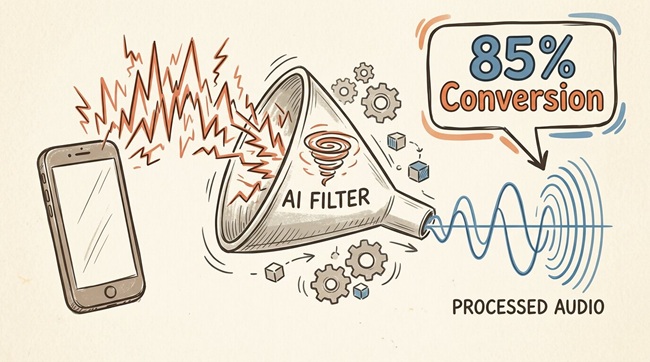
What: Implement an AI buffer that validates emotion before attempting to book the job.
How: Script the AI agent to use specific acknowledgement phrases before moving to technical triage. If a customer says, "I've been waiting three hours," the AI does not say, "What is your address?"
Instead, it says, "I can hear how frustrating that is, especially after waiting so long. Let's get this sorted for you." It mirrors the "step into the client's shoes" philosophy. The AI does the stepping in so your admin team or technicians don't have to walk into a minefield blindly.
Success Indicator: The primary metric here is conversion through de-escalation. VoiceAiro converts 85% of inbound calls into booked jobs by using this specific protocol. The customer feels understood, so they agree to the appointment.
Pitfall: Rushing to the calendar slot. Customers expect a response within 10 minutes, and 73% will abandon if the wait exceeds 5 minutes. But speed without empathy is useless. The AI must be immediate and empathetic.
Pro Tip: Configure the AI to use 'mirroring' techniques. If a customer uses high-intensity words like 'disaster' or 'nightmare', the AI should acknowledge that specific severity before moving on.
Step 2: Automated Sentiment Triage
Not all calls are created equal; a minor technical issue can be a major emotional crisis for a stressed client. Treating every call with the same standard process risks missing these critical retention opportunities.
What: Categorise calls based on emotional intensity, not just technical fault. A minor leak for a stressed client is a high-priority retention risk.
How: Use AI sentiment analysis to flag "at-risk" clients immediately. The system analyses tone, volume, and keywords to detect frustration via Natural Language Processing (NLP). This gives your business a defensive layer against churn. You know who is angry before the technician arrives.
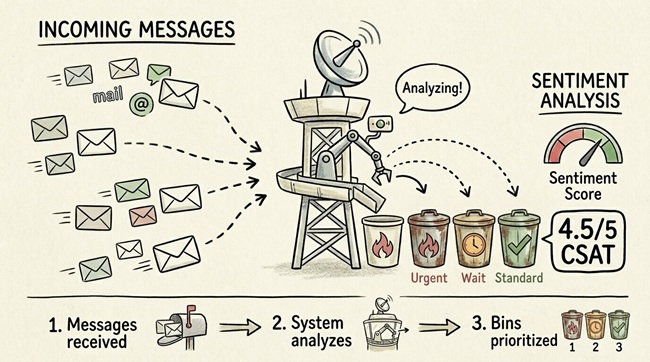
Success Indicator: Zero surprise escalations for field technicians. When you get this right, satisfaction scores soar. Hybrid approaches (AI + Human) achieve a 4.5/5 CSAT score, compared to just 4.0 for AI only or human-only workflows that lack data.
Pitfall: Treating a VIP with a minor issue the same as a cold lead. If your top commercial client calls with a small problem but high frustration, the system must flag it as "Urgent Retention Risk," not "Standard Maintenance."
Skeptical that an AI can solve a 25% churn rate? See the real-world metrics from Australian home service businesses that implemented this 'listen first' strategy.
Step 3: The Context-Rich Handoff
Information loss between the office and the field is a common source of friction. Technicians need more than just the job details; they need the emotional context to approach the client correctly.
What: Transfer the "emotional context" to the technician, not just the job details. It solves the persona pain point: "My guys are fixers; they naturally want to jump in and solve the problem."
How: Integrate voice AI with platforms like ServiceM8 or SimPro to deliver a summary directly to the tech's mobile. The note doesn't just say "Fix AC unit." It says: "Client is stressed about cost and felt ignored last time. Approach with reassurance."
Success Indicator: The technician arrives with the right soft-skill approach. Gartner projects conversational AI reduces service labour costs by $80 billion by improving retention and efficiency. When the tech knows the context, they don't waste time arguing or calming the client down; they just do the work.
Pitfall: Making the client repeat their story. 49% of customers still prefer a live person for complex issues, but they hate repeating themselves. The handoff must be seamless. The tech should say, "I see you spoke to our system about the delay, I'm here to fix that," proving the internal communication works.
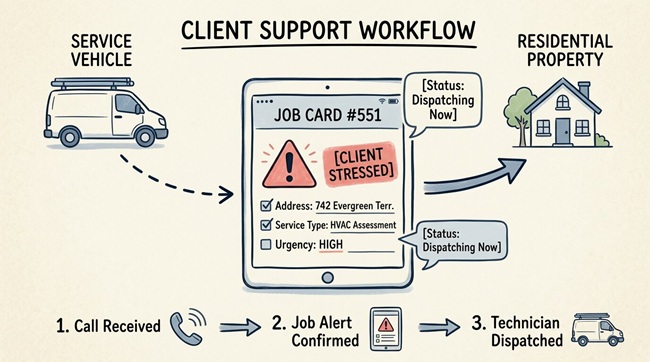
Pro Tip: Configure your dispatch software to display the 'sentiment score' in red next to the job address so technicians can't miss it before they knock on the door.
Step 4: The "Validation" Service Call
The physical arrival of the technician is the moment of truth for the customer experience. This step ensures the empathy established during the call is carried through to the face-to-face interaction.
What: Execute the "Listen First" insight physically at the job site.
How: Technicians use the briefing notes to acknowledge the specific pain point raised in the initial call before opening their toolbag. It is a repeatable process, not a feeling. They validate the client's frustration immediately.
Success Indicator: The client verbalises relief ("Thanks for understanding"). 76% of Australian firms need more action on feedback to build trust. When your technician acts on the initial feedback immediately, trust is established. Businesses using AI support in this way see a 2-3x increase in team productivity because they spend less time managing conflict.
Pitfall: Ignoring the briefing notes and reverting to standard "fix-it" scripts. If the tech walks in and asks "So, what's the problem?" after the client already explained it, you have undone all the work.
Step 5: Proactive Retention Modeling
Churn often happens silently, with customers leaving without a formal complaint. By the time you notice the drop in revenue, it is often too late to save the relationship.
What: Use call data to predict future churn before it happens. It addresses the commercial reality of losing profitable, long-term clients.
How: Analyse call transcripts for keywords like "cancel," "expensive," "competitor," or "disappointed." C5.0 models in home care and services enable proactive retention, reducing baseline churn by 20%.
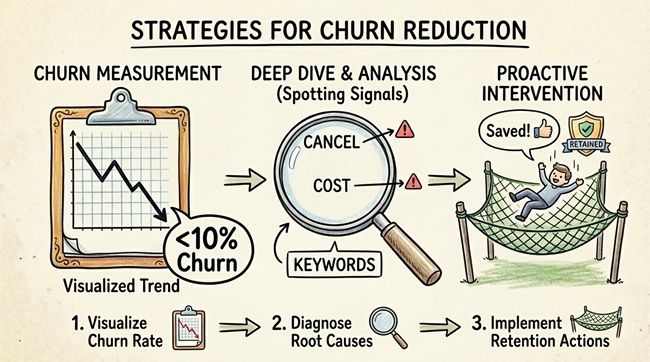
Success Indicator: Reducing annual churn from 25% to under 10%. You stop the leak.
Pitfall: Ignoring the "silent churn." 63% of Australian businesses struggle to track churn rates effectively. Many customers don't complain; they just leave. By analysing subtle cues in conversation history, you can catch the ones who are quietly unhappy.
Measuring Success: KPIs and Optimisation
To ensure this framework delivers ROI, you must track the right metrics.
Primary Metric: Reduction in Churn Rate (Target: <15%).
Leading Indicator: First Contact Resolution (FCR). Hybrid models achieve high FCR because the AI handles the intake perfectly, and the human handles the execution perfectly.
Optimisation: Refining the AI's "Aussie" accent. Trust is built on local understanding. VoiceAiro's specific capability to use local idioms ensures the customer feels they are speaking to a local team, not an offshore call centre.
Advanced Considerations for Multi-Van Fleets
Scaling empathy across 20+ technicians requires rigid process adherence. Property management portfolios lose 250 doors a year at 25% churn. Fleets face similar scale risks.
You must handle multi-location compliance and varying regional customer expectations. Integrating AI data directly into dispatch boards gives you real-time visibility into which jobs are "hot" (emotionally) and which are standard.
AI reduces operational costs by up to 40% by automating the intake and triage, enabling your dispatchers to focus on logistics rather than conflict resolution.
Ready to stop losing customers and start converting 85% of your inbound calls into jobs? Book your discovery call and get a tailored plan for your home services business.

